Stage 3: Ideate
Mind Map
How might we focus on helping employees do energy building work every workday?
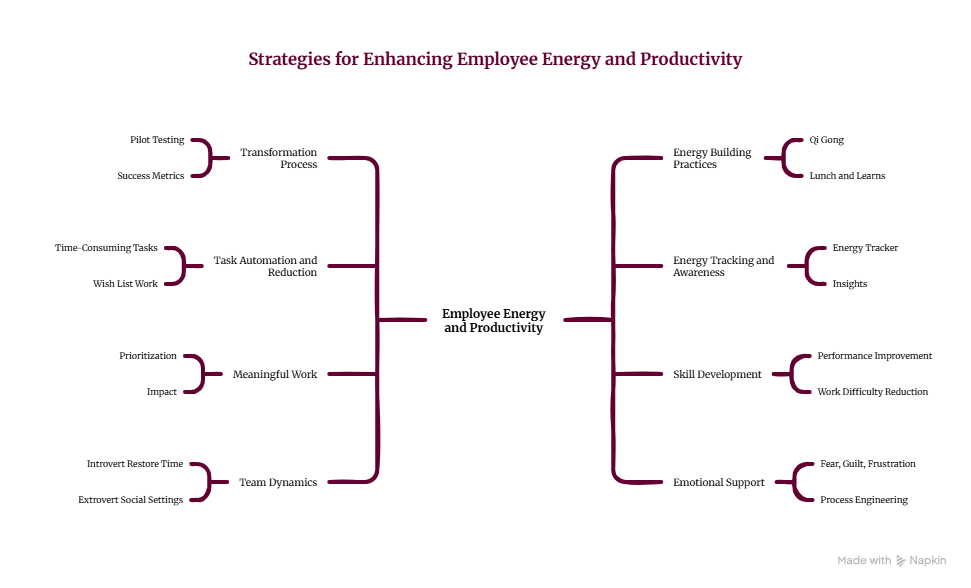
Mindmap Ideas
- I can establish a transformation process and pilot test with my co-workers on the project management team, while measuring success metrics to get buy-in with executives to apply company-wide.
- Introduce energy building (Qi Gong) practices with lunch and learns to give people tools to start tracking their own energy levels throughout the day.
- Automate or reduce the most time consuming task and add “wish lish” work onto the people’s plates with the freed up time.
- Have each employee list 3-5 work tasks they do not like (that drain their energy) and partner with each person to help reduce that work, distribute it to someone else, or automate it so nobody has to do it.
- Have people track what fuels them vs decreases their energy consumption. Track each AM, afternoon and PM a energy tracker. Build awareness and have them take notes on insights.
- Add a energy measurement to scoping work in project management (team motivation for working on each project)
- Add meaning to the work being focused on – why are we prioritizing this work? Why does it matter?
- Support people in learning and raising their performance so work is less difficult.
- Allow introverts more restore time and create more social settings for extroverts on teams. Respect both sides and offer options for the employee to decide. Ex. Have online working sessions or office hours the team can get work done together while connecting (like a coffee shop) BUT also offer heads down quiet time for introverts that want alone time.
- I could interview teammates to find out what work causes Fear, Guilt or Frustration and find ways to automate/reduce time to complete those tasks. I could also apply process engineering to make work easier overall.
Value Proposition Workbook
Method 1: User Context & Identification
- Target Audience: Gen Z to Gen X employees and contractors working in corporations across America who feel burned out, overwhelmed, and disconnected from work that aligns with their authentic passions and unique skills.
- Deeper Motivation: They want more work-life balance, more meaningful work, and less time spent on energy-draining tasks.
- Status Quo: Many employees try to solve this by working extra hours, losing sleep, absorbing more work as high performers, or quietly quitting when the workload becomes unrealistic.
- Primary Emotions: Fear, guilt, frustration, anger, overwhelm, and decision fatigue caused by unclear processes, shifting priorities, and lack of alignment.
Method 2: Requirements Mapping
- Functional Job: Complete day-to-day work tasks that often require real-time decision-making, take too much time, or are constantly interrupted before completion.
- Social Job: Employees want to be seen as reliable, productive, smart, helpful, and independent.
- Emotional Job: Employees want to feel accomplished and understand how their work creates helpful impact for others.
- Hire/Fire Moment: The solution would help employees “fire” chaos, uncertainty, unnecessary manual work, and energy-draining tasks.
Method 3: Pain Points & Friction
- Main Barrier: Time. Employees need more time freed up so they can reduce draining work and move toward work that builds energy.
- Risk: Employees may worry that if their work becomes easier or more aligned, the company may undervalue them or eliminate their role.
- Cost of Inaction: If nothing changes, employees may quit, quietly quit, or continue suffering through burnout and disengagement.
- Ugly Truth: Many employees force themselves through draining work, procrastinate to avoid it, or rush through it under stress.
Method 4: Benefit Identification
- Dream State: Employees spend most of their workday doing energy-building activities, feel productive, sleep better, and have energy left for life outside of work.
- Unexpected Delight: The solution could help employees gain energy for hobbies, health, rest, personal growth, and discovering their deeper life work.
- Success Metrics: Energy levels, mood, sleep quality, personal performance, time saved, engagement, and time redirected toward meaningful work.
- Value Pivot: The solution helps employees become more connected to what they are passionate about and more protective of how they use their time.
Method 5: Competitive Differentiation
- Only-ness Statement: We are the only workplace energy optimization system that helps burned-out employees shift from energy-draining work into energy-building work for long-term performance and wellbeing.
- Secret Sauce: The solution combines energy tracking, process improvement, workload redesign, automation, and human passion alignment into one measurable transformation system.
- Trade-off: We are willing to be bad at maximizing short-term output through constant pressure so we can be world-class at sustainable energy, meaningful productivity, and long-term human performance.
- Evidence: Employees track which tasks increase or drain their energy while managers identify opportunities to automate, redistribute, simplify, or redesign draining work.
- Radical Clarity: We help people spend more time doing work that gives them energy instead of work that drains them, so they can feel happier, healthier, and more excited about life and work.
Venn Diagram
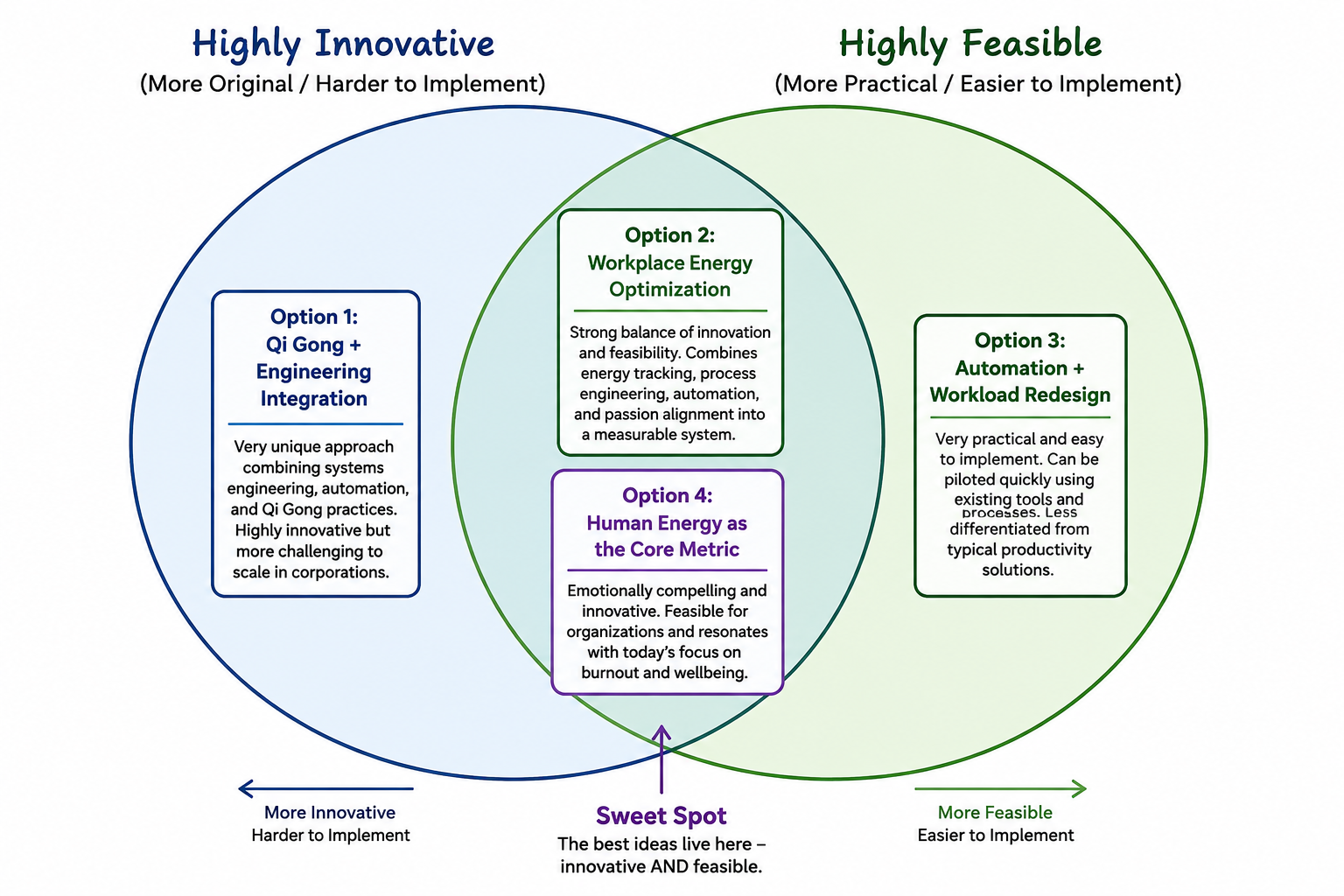
-
Option 1: Qi Gong Energy + Engineering Integration
“Our energy alignment transformation program helps employees experiencing burnout and overwhelm who want more peace, purpose, and balance in their workdays by reducing stress, emotional exhaustion, and draining work patterns while increasing energy awareness, meaningful productivity, and wellbeing. Unlike standard corporate wellness programs, we integrate systems engineering, automation, and energy practices like Qi Gong into daily work design.”
-
Option 2: Workplace Energy Optimization
“Our workplace energy optimization system helps burned-out employees and project teams who want to do more meaningful, energy-building work by reducing repetitive, chaotic, and energy-draining tasks and increasing alignment, wellbeing, productivity, and sustainable performance. Unlike traditional productivity systems that prioritize output over people, we combine energy tracking, process engineering, automation, and passion alignment into one measurable transformation system.”
-
Option 3: Simplified Solution
“We help burned-out employees spend more time doing energy-building work by reducing repetitive and draining tasks through automation, energy tracking, and workload redesign.”
-
Option 4: Energy Engineering
“Our solution helps overwhelmed employees reclaim their energy and reconnect with meaningful work by reducing burnout, chaos, and exhausting manual tasks while increasing balance, clarity, and fulfillment. Unlike traditional workplace productivity systems, we believe human energy is the most important metric of success.”